The Escalation Matrix: Who Hears About a Problem, and How Fast
Most bad surprises in contract manufacturing aren't hidden on purpose. The SMT line stops at 10pm, the night shift tries to fix it, and the operations manager finds out at 7am. A customer's goods-in team spots a late delivery before your planner has told them. A shortage that purchasing knew about for a fortnight reaches the production meeting on the day the kits should have gone to the line.
Nobody meant to keep quiet. There was no written rule for who needed to hear, and how fast. An escalation matrix is that rule, on one page.
If it isn't written down, it isn't a standard
"Ring me if anything big happens" means something different to every team leader, and something different again at 2am. People need a page they can read in the middle of a bad shift and know whether this one gets a phone call. Print it, and put it by the line phone and in the shift handover file.
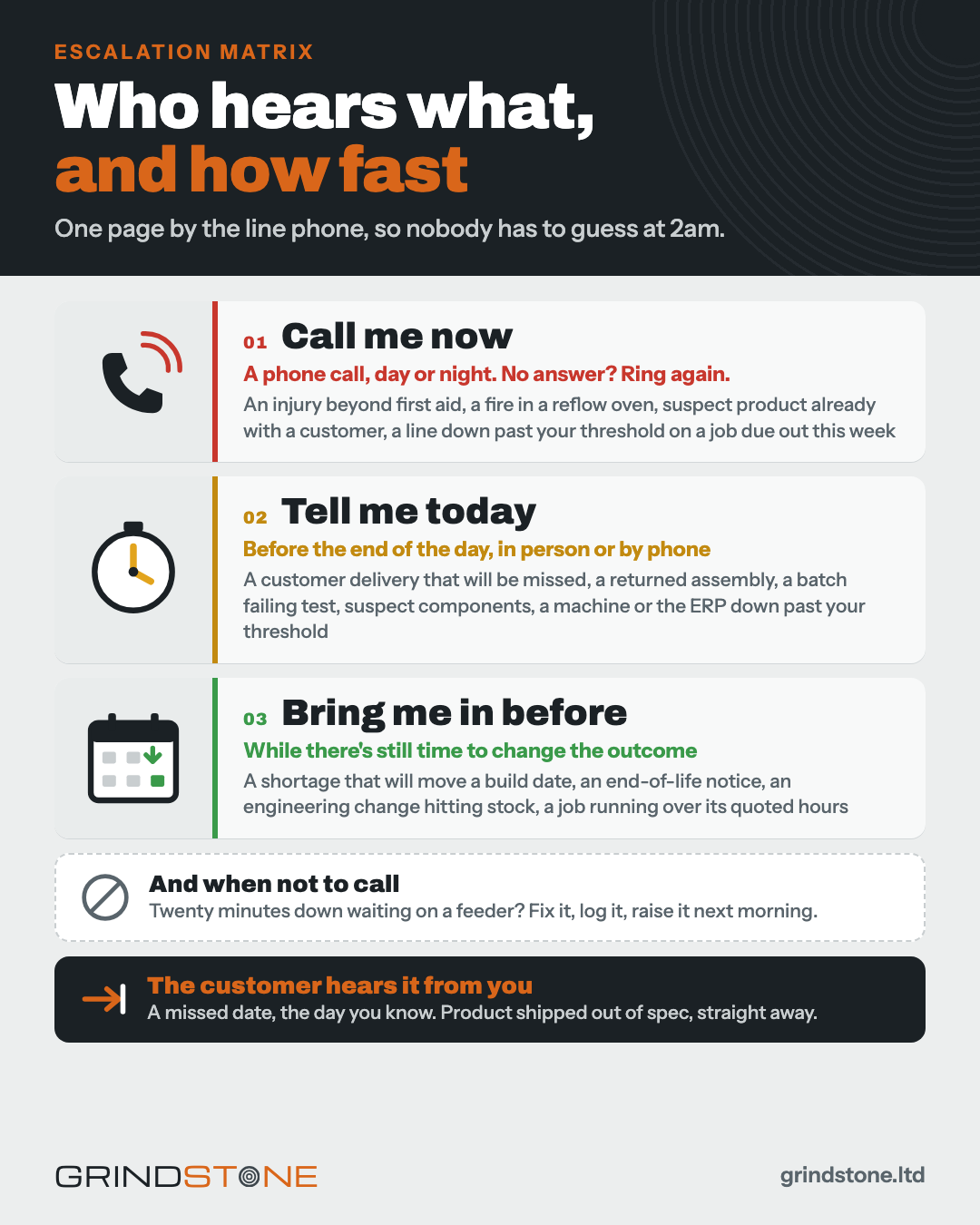
The matrix sorts problems into three tiers, by how fast the manager needs to hear.
1. Call me now, day or night
Problems that can't wait for the morning:
- an injury that needs more than first aid
- a fire, including one inside a reflow oven or wave solder machine
- an HSE inspector on site, or an unannounced notified body audit if you build medical devices
- suspect product already with a customer, on a job where it could affect safety
- a line down past your threshold on a job due to ship this week
A phone call, not a text. If nobody answers, ring again, then ring the next name on the list.
2. Tell me today
Problems the manager needs to know about before the end of the day:
- a customer delivery that is going to be missed
- a customer complaint or a returned assembly
- a quality problem found in-house: a batch failing test, a repeating AOI or X-ray fault, a wrong part fitted
- suspect components, such as parts from a non-franchised source that don't match their paperwork
- a machine or system (the ERP, a test station) out for longer than your threshold
- a key person handing in their notice
3. Bring me in before it happens
Problems you can see coming, while there's still time to change the outcome:
- a shortage that will move a build date: a part on allocation, a lead time that has moved out, an end-of-life notice
- an engineering change that affects work in progress or stock
- a job running over its quoted hours or cost
- a customer schedule change the plan can't absorb
- a first article or NPI build that is likely to slip
Set the thresholds, and say when not to call
A threshold is the point where a problem moves into a tier. It has to be something the person on shift can measure without making a judgement, so that two people reading the matrix at 2am make the same call. "A long stoppage" or "a serious quality problem" isn't a threshold, because everyone reads it differently.
Four kinds of threshold work well:
- Time: the line has been down for more than two hours.
- Quantity: five or more assemblies have failed the same test in one shift.
- Money: a job is more than 10% over its quoted hours.
- Customer: the job is due to ship this week.
The same problem can sit in more than one tier, with a different threshold for each. A line down for thirty minutes is for the team to handle. Over two hours, the manager hears about it today. Over two hours on a job due out this week, it's a phone call now.
Every site sets its own numbers. Two hours of line-down might be right for a site with one SMT line, four for a site with spare capacity. The exact number matters less than writing it down, because the thresholds tell people what matters.
The matrix should also say what doesn't need a call. If the line is down for twenty minutes waiting on a feeder, the team fixes it, logs it and raises it at the morning meeting. Without that line, the manager becomes the bottleneck and the calls that matter get lost among the ones that don't.
Fewer calls: give the team the authority to act
A good matrix gets quieter over time. The aim is fewer problems that need a call, because the people nearest the problem can deal with it themselves.
- Write down what the team can decide without asking. Put it on the same page as the matrix, with a limit on each: move the next job forward while a line waits on parts, book overtime up to an agreed number of hours, call in the maintenance contractor, quarantine suspect stock.
- Give team leaders a first-response guide for the common stoppages. For the faults you see every month, such as feeder errors, a paste printer out of alignment or a test fixture failing, one page that says what to check, in what order, and when to stop and escalate.
- Train a second person on every critical machine and test. A training matrix shows where one absence leaves a line down until the morning. Our free training matrix template uses a 0 to 4 scale and flags any skill with fewer than two competent people.
- Keep spares and contacts in the shift file. Critical spares, the maintenance contractor's out-of-hours number and the equipment supplier's technical support line, where the night shift can find them. Our free critical spares template covers the spares list, minimum stock, who reorders and the service contacts.
- Back the decisions the team makes. If a team leader uses their authority and it doesn't work out, review the decision, not the person. Otherwise they go back to calling about everything.
- Review the calls every month. For each one, ask whether the team could have handled it with the authority, the skills or the part. If they could, give them that, and move the item off the matrix and onto the list of decisions the team makes.
Your customers are on the matrix too
In contract manufacturing, escalation doesn't stop at your own managing director. Your customer should hear about a problem from you, before their goods-in, their production line or their own customer tells them. Add a column for who tells the customer, and how fast:
- A missed delivery: the customer's buyer, on the day you know, with a new date.
- Non-conforming product already shipped: the customer's quality contact, straight away. If you work to AS9100, ISO 13485 or IATF 16949, check the customer's quality agreement, which may set its own timescale.
- A change the customer has to approve: a new part, process or supplier, raised before it happens, not after.
The same goes for suppliers. When a delivery slips past the date your plan needs, it goes to the supplier's account manager the same day, rather than into another chase email.
Why people don't make the call
Most people who sit on a problem think they can fix it before anyone notices, and ringing a manager at night feels like admitting failure. The matrix takes that judgement away: if it's on the list, you call.
What happens after the first early call decides whether the standard sticks. If the caller gets a grilling, the next problem waits until morning. Thank people for calling early, especially with bad news, and use the call to help: approve the overtime, book the premium freight, or ring the customer yourself.
Build yours this week
- Download our free escalation matrix template (fillable PDF), or take a blank page and write three headings across the top: Call me now, Tell me today, Bring me in before.
- List the problems you'd least want to hear about late, across safety, quality, delivery, materials, machines, cost, people and outside visits. Put each one under a heading.
- For each one, write a measurable threshold, who gets told inside the business, who tells the customer or supplier, and how fast.
- Add what the team can decide without a call, and the limit on each.
- Walk your supervisors, team leaders and your own boss through it, and ask what's missing.
- After 30 days, check what still surprised you, update the page and reissue it. Give it a revision and a date like any other controlled document.
It won't be perfect the first time, and it doesn't need to be. A page by the line phone that everyone uses beats a perfect procedure nobody has read.
How Grindstone helps
Grindstone runs this as a workshop with your managers and team leaders, on your site or remotely. You leave with an escalation matrix agreed by the people who will use it, the list of decisions your team can make on its own, and a plan for the training and spares gaps that cause the most calls. Every job has a fixed price, agreed before we start. Talk to us about a workshop.