SOP or Work Instruction? What's the Difference
Standard operating procedures (SOPs) and work instructions are often treated as the same thing. They do different jobs, and most manufacturers need both. Getting the split right makes each one shorter, easier to follow and easier to keep up to date.
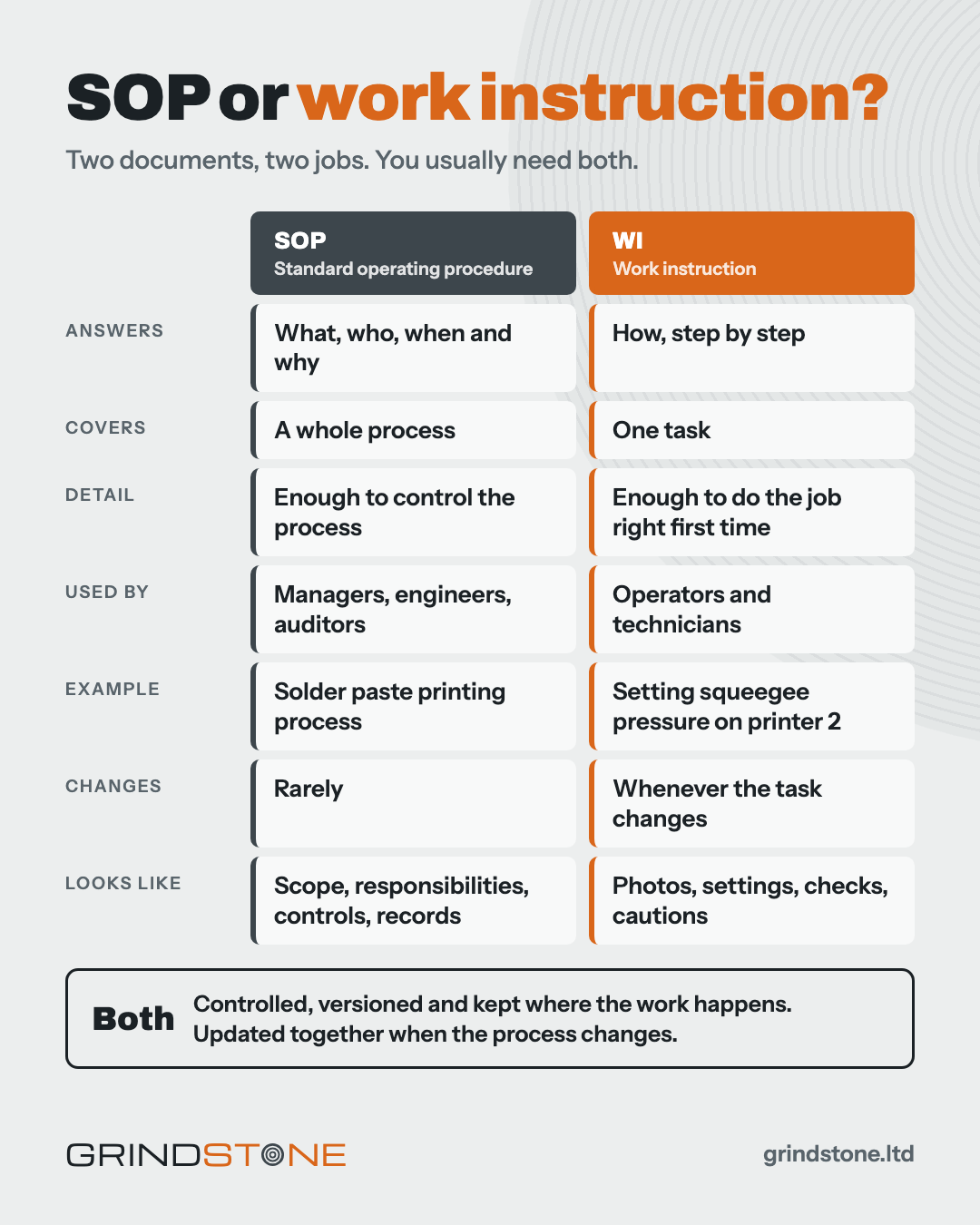
The SOP: how the process is controlled
An SOP describes a whole process: what happens, who is responsible, when it happens and why. It sets out the controls and the records that prove the process ran as it should. Managers, engineers and auditors use it, and it changes only when the process itself changes.
For example, a solder paste printing SOP would cover who sets up the printer, which stencils and pastes are approved, how often prints are inspected, what happens when an inspection fails, and which records are kept.
The work instruction: how the task is done
A work instruction describes one task, step by step, for the person doing it. It gives the settings, the checks and the cautions, ideally with photos taken on your own equipment. It changes whenever the task changes, so it needs to be quick to update.
For example, a work instruction might show how to set the squeegee pressure, speed and separation on printer 2 for a particular product, with a photo of each setting and the result to check before running.
How they fit together
The SOP says the paste print is inspected every 20 boards. The work instruction shows the operator exactly how to inspect it and what a good print looks like. Each SOP should point to the work instructions it relies on, so when one changes, the other is checked too.
Keeping both useful
- Write work instructions with the people who do the task. They know the steps that are missing.
- Use photos, not paragraphs. One clear photo of the right setting beats a page of text.
- Keep them where the work happens. At the machine, on a screen or a laminated sheet, not only in a system.
- Control the versions. Every copy on the floor should be the current one, with a revision and date.
- Update them as part of every change. An engineering change, a new fixture or a kaizen is not finished until the work instruction matches.
ISO 9001 asks for the documented information a business needs to run its processes, rather than for SOPs by name, and many customers and sector standards expect more. Either way, documents that match how the work is really done are what make the difference.
Our free kaizen improvement sheet includes a step for updating standard work and instructions after an improvement. If you'd like help writing or reviewing your procedures and work instructions, see our Consultancy page.