Visual Management on the Shop Floor: One Question per Board
Visual management is easy to start and easy to overdo. A wall of charts nobody reads is worse than one board everyone uses. A simple test helps: each board, mark or signal should answer one question, for anyone walking past, in a few seconds.
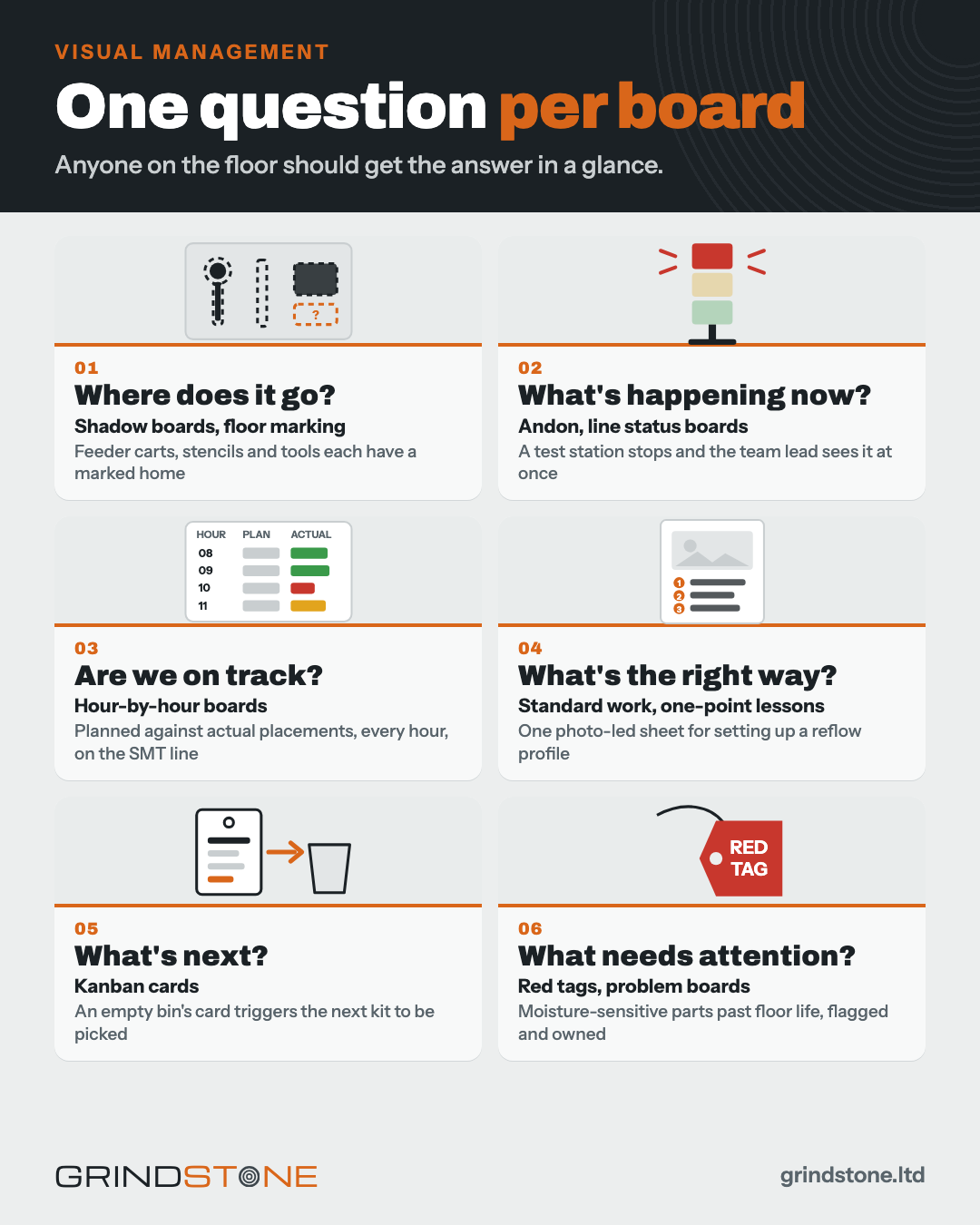
Six questions worth answering at a glance
- Where does it go? Shadow boards, floor marking and labelled locations give everything a home, so missing items stand out. Feeder carts, stencils, squeegees and test fixtures are good places to start on an electronics line.
- What's happening now? Andon lights and line status boards show at once when a station has stopped or needs help, so the right person goes straight there.
- Are we on track? An hour-by-hour board shows plan against actual while there's still time to recover. Write the reason for any shortfall next to the number, in the operator's words.
- What's the right way? Standard work and one-point lessons show the method at the point of use: one photo-led sheet for a reflow profile set-up beats a binder in the office.
- What's next? Kanban cards and boards signal what to make or move next, such as an empty bin card that triggers the next kit to be picked.
- What needs attention? Red tags and problem boards make abnormal things visible and give each one an owner, such as moisture-sensitive parts past their floor life.
Making it stick
- Design it with the people who use it. If the team can't read the board in five seconds, change the board, not the team.
- Keep it current. A board updated at the start of every shift is trusted; one updated weekly is ignored. Make updating it part of the job.
- Act on what it shows. A short stand-up at the board, with problems given an owner and a date, is what turns a display into a tool.
- Use colour consistently. Green for normal, amber for at risk, red for stopped, the same everywhere on site.
- Retire what nobody uses. Walk the floor every few months and take down anything that no longer answers a question.
The gemba walk ties it together: managers go to the boards, ask what they show and what help is needed, and follow up.
If you'd like help setting up visual management on your shop floor, see our Consultancy page. Our free kaizen improvement sheet is a good way to capture the improvements the boards bring to light.